Who We Are
About the Library
The library represents a continuing effort to preserve knowledge, memory, and cultural heritage through the care of historic texts and manuscripts.
Inside the Library
Where the Manuscripts Are Held and Cared For
Why the Collection Matters
A Place of Preservation
A manuscript library exists to do more than store objects. Each volume in its care requires careful handling, stable conditions, and ongoing conservation, so that fragile pages, bindings, and inks survive for future generations to study. Alongside preservation sits the work of documentation: recording condition, provenance, and content in a form that scholars and practitioners can consult.
Together, these efforts turn a collection of individual objects into a shared resource and safeguard a body of cultural memory that would otherwise be vulnerable to loss. A catalogued, well documented collection can be consulted by researchers, students, and practitioners without placing further strain on the original materials. The library’s task is to hold this balance: protecting what is fragile while keeping the tradition it represents open to study.
Digital Preservation
Capturing Fragile Pages Without Touching Them Again
Digitisation
From Preservation to Access
Digitisation extends the life of a manuscript without altering the original. High resolution photography and careful digital documentation allow a fragile page to be examined closely, compared, and shared, all without further handling of the physical object. This is particularly important for material that is delicate, damaged, or held as a single copy, where every additional handling carries risk.
Digitised images also make cataloguing more thorough. Each manuscript can be recorded with consistent metadata, cross-referenced with related material, and made available for research in a way that would be difficult with physical access alone. Over time, this digital record becomes its own form of preservation: a lasting reference that remains available even as the original continues to be cared for in the library.
Historical and Devotional Context
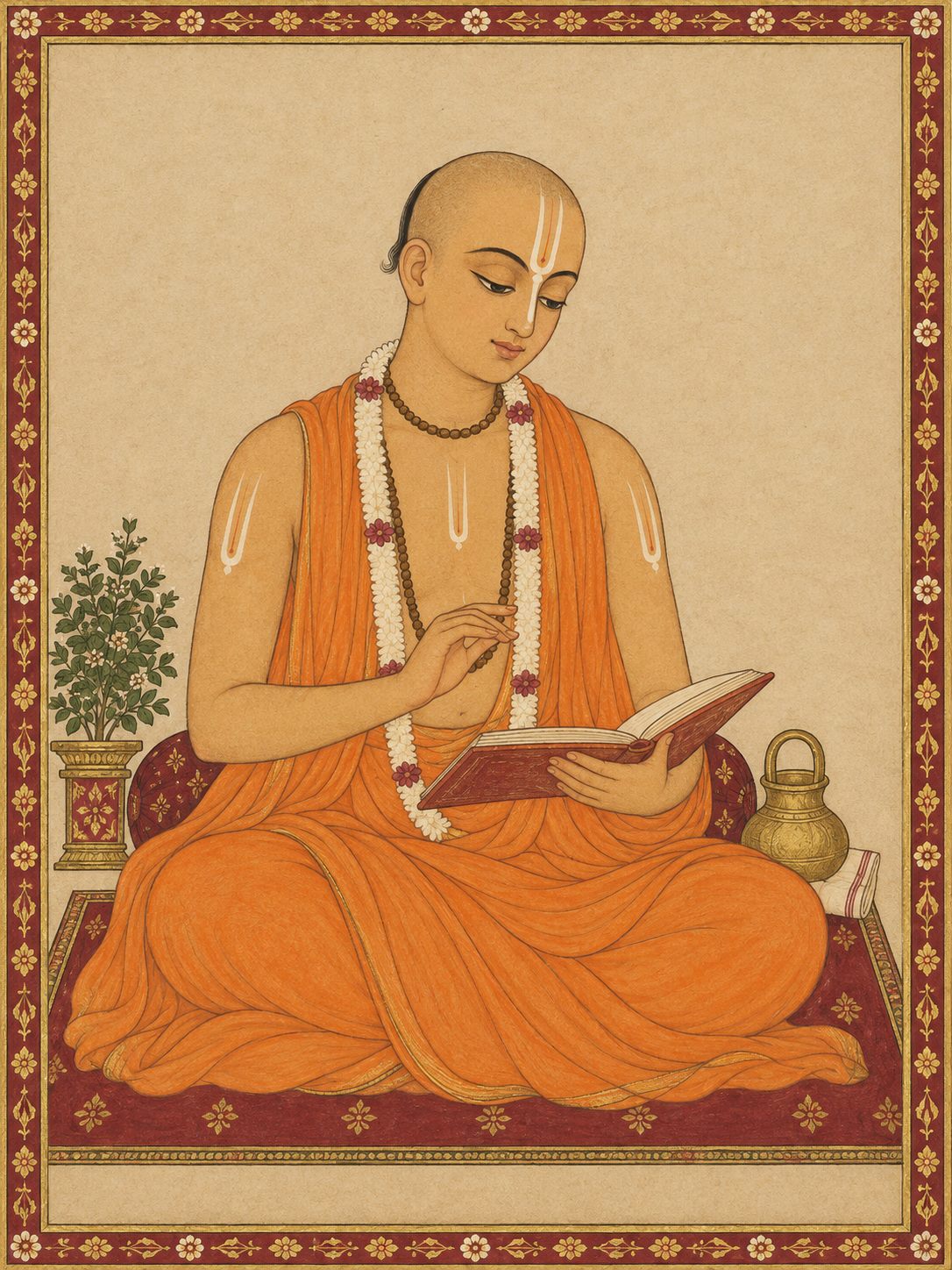
Raghunath Bhatta Goswami
Raghunath Bhatta Goswami is counted among the six principal Goswamis associated with Sri Chaitanya Mahaprabhu. Born in 1562 in the village of Rampur Bayotia, eastern Bengal, he became one of Vrindavan’s most beloved reciters of Srimad Bhagavatam.
Life and Legacy
A Voice Devoted to Srimad Bhagavatam
His father, Sri Tapan Misra, was an eminent scholar and devoted follower of Sri Chaitanya Mahaprabhu. When Mahaprabhu travelled toward Vrindavan by way of Kashi, he stayed at Tapan Misra’s home for two months, and the young Raghunath Bhatta, then only around ten, received the opportunity to personally serve him. The experience awakened such vairagya that he later sought Mahaprabhu’s darshan at Jagannath Puri, only to be instructed to first return home, serve his parents, and take up renunciation afterward.
He later returned to Vrindavan, where he remained in the company of Sri Rupa and Sanatan Goswami. His devotion found expression above all through the recitation of Srimad Bhagavatam, presented not as intellectual exposition but as an act of devotion infused with remembrance and love for Sri Krishna; he is regarded as the originator of the Sri Bhattji Samaj tradition of collective Bhagavata-lila singing in Vraja. He lived for approximately forty-nine years, and his disappearance on Ashvina Shukla 12, Vikrama Samvat 1611 is marked at his samadhi near the Sri Govinddev Ji temple a legacy his disciple and successor, Sri Gadadhar Bhatta Goswami, carried forward, as told below.
Objects of Devotion
Sacred Objects Associated with Raghunath Bhatta Goswami
A small number of sacred objects connected with Raghunath Bhatta Goswami are preserved within the lineage. A fuller record of each, with photographs and provenance, will be added to this page as it is documented.
Srimad Bhagavatam
Preserved within the lineage · detailed record to follow
Tulasi-mala
Preserved within the lineage · detailed record to follow
Paduka (Footwear)
Preserved within the lineage · detailed record to follow
Disciple and Successor
Gadadhar Bhatta Goswami
Sri Gadadhar Bhatta Goswami was a prominent Vaishnava acharya in the parampara of Sri Raghunath Bhatta Goswami, renowned for his profound devotion to Sri Krishna and his absorption in Srimad Bhagavatam. Born to a South Indian Brahmin family of Telugu origin, he later made Vrindavan his home.
The Journey to Vraja
Called to Vrindavan
Even before coming to Vrindavan, Gadadhar Bhatta was composing deeply devotional padas. One such pada, beginning “Sakhi, haun Syam rang rangi”, reached the ears of Sri Jiva Goswami, who was so moved that he sent two associates bearing a personal letter of a single Sanskrit verse, pointing toward the centrality of Sri Radha’s lotus feet and Vrindavan-dhama. On receiving it, Gadadhar Bhatta was overcome with spiritual emotion, and it became the immediate catalyst for his journey to Vraja.
Sri Jiva Goswami arranged for him to receive diksha from Sri Raghunath Bhatta Goswami, and he carried forward his guru’s tradition of Bhagavata recitation, devotional narration and loving service. His life and poetic legacy are remembered in the Bhaktamal of Nabhadas and in Sri Gadadhar Bhatta Ji ki Vani, a collection of around eighty-five padas. Sri Radha-Madanmohan Lal is revered as his sevya-svarupa, worshipped to this day within the Gadadhar Bhatta Goswami lineage at Atkhamba, Vrindavan a succession told in full on the Lineage page.